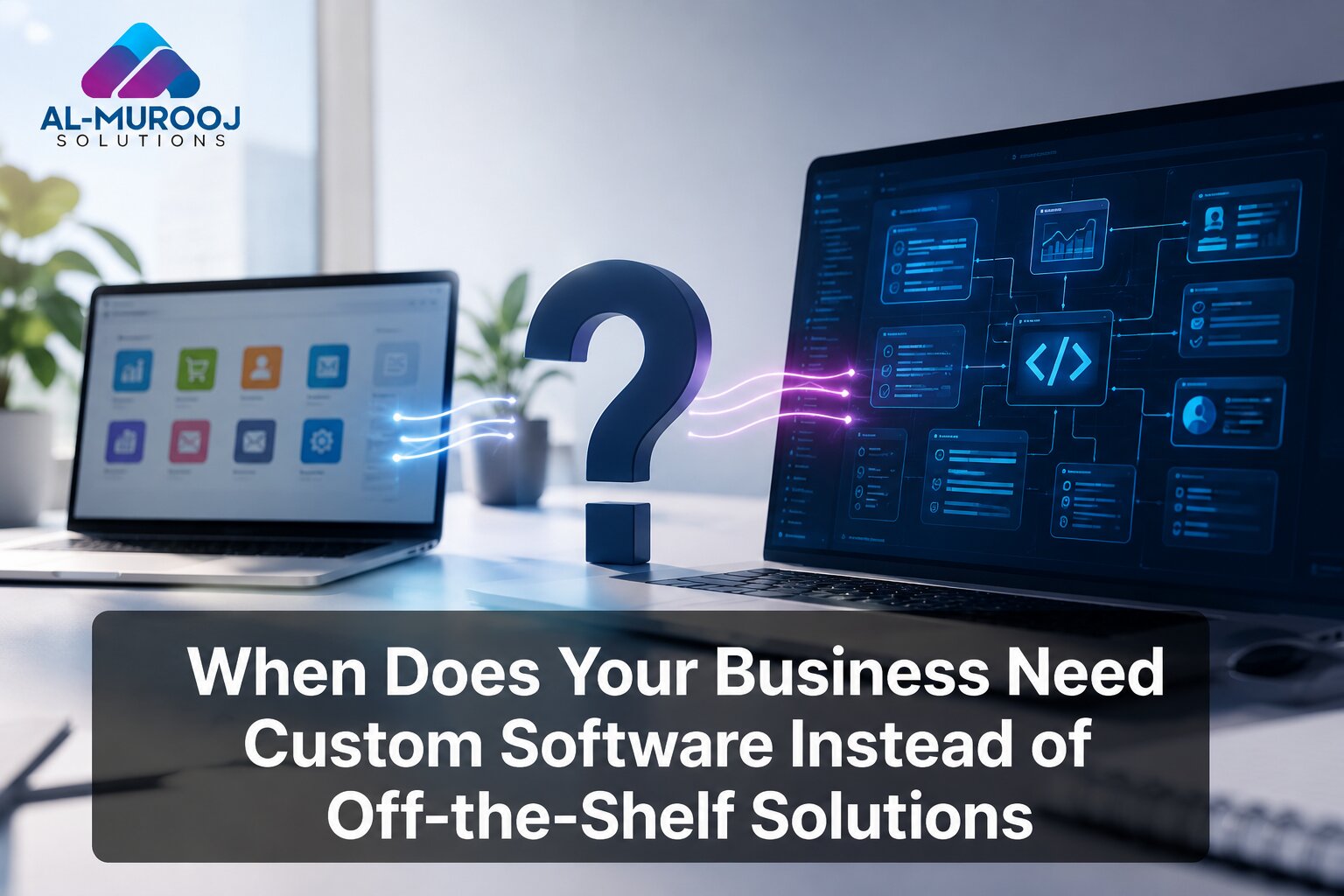
You bought the software everyone recommended. It ran smoothly for the first year. Now your team fights it every single day.
This is one of the most common calls a software development company in Dubai gets. Business owners aren’t sure if their problem is “normal” or a sign they’ve outgrown their system. If you’re asking that question right now, this guide will help you answer it. At Al Murooj Solutions, we walk Dubai businesses through this exact decision every week, so let’s break it down honestly, without the sales pitch.
The Off-the-Shelf Trap: Why It Works Until It Doesn’t
Off-the-shelf software is built for everyone. That’s the whole point.
It’s cheap to start. It’s fast to set up. For a small team with simple needs, it does the job well.
But “built for everyone” also means built for no one specifically. As your business grows, the cracks start to show. You add workarounds. Then more workarounds. Then, a spreadsheet to fix the workaround.
It’s frustrating to keep patching a system that should just work. You’re not doing anything wrong. Your business has simply changed faster than your software.
Signs Your Business Has Outgrown Generic Software
Here’s the honest part. Most companies don’t realize they’ve hit this point until the pain becomes constant. Watch for these patterns.
Process problems:
● Staff keep private spreadsheets outside the main system
● Approvals happen over email or WhatsApp, not the software
● The same data gets typed in twice, sometimes three times
Reporting problems:
●You can’t get a real-time view of what’s happening
●Building one report takes hours of manual work
● Management makes decisions on gut feeling, not current numbers
Integration problems:
● Your CRM and accounting system stay cut off from each other.
● Inventory numbers don’t match across platforms
● Someone manually moves data between tools every week
Scalability problems:
● The system slows down as more staff log in
● Adding a new branch means starting from scratch
● Licensing fees climb faster than your headcount
If two or three of these sound familiar, it’s worth a proper conversation. If all of them do, off-the-shelf software is likely costing you more than custom software would.
When Off-the-Shelf Software Is Still the Right Choice
Here’s something a lot of vendors won’t tell you. Custom software isn’t always the answer.
If your operations are simple, stay simple. A small team with standard processes doesn’t need a custom build. Neither does a business with minimal integrations or no real growth plans on the horizon.
Buying custom software you don’t need is a waste of budget. A good technology partner should tell you this upfront, even if it means a smaller invoice today. That honesty is what builds a working relationship, not a one-time sale.
When Custom Software Becomes the Smart Investment
Now here’s the flip side. Some situations genuinely call for a custom build.
Business complexity. You’re running multiple departments, multiple branches, or approval chains that off-the-shelf tools simply can’t map.
Unique workflows. Your industry has specific requirements that generic software wasn’t designed for. You’re bending your process to fit the tool, instead of the other way around.
Integration needs. You’re using several systems that need to share data right away, not through manual exports and imports.
Reporting needs. You need live dashboards and custom analytics, not static templates built for a generic business.
Scale. You’re growing fast, opening new locations, or handling rising transaction volume that your current system wasn’t built to carry.
Imagine a mid-sized logistics company in Dubai juggling five spreadsheets just to track one shipment. That’s not a training issue. That’s a software problem, and it’s exactly where custom development starts to pay for itself.
The Hidden Cost of Waiting Too Long
Sticking with the wrong system rarely feels urgent. It feels annoying, not dangerous.
But every workaround has a cost. Every duplicate entry wastes staff time. Every delayed report slows a decision that mattered.
Add it up over a year, and the real price becomes clear. Lost hours. Missed opportunities. Frustrated employees doing manual work a system should handle.
Waiting doesn’t avoid the cost of custom software. It just moves that cost somewhere quieter into your team’s time instead of your budget. The longer you wait, the harder the switch becomes, because more of your business gets built around the broken process.
What to Prepare Before You Contact a Developer
You don’t need a technical spec to start this conversation. You need clarity on your problems.
Write down where your current process breaks. Note which tasks eat the most time. List the systems that don’t talk to each other.
Bring your team into it too. The people using the software daily often see issues leadership misses.
You don’t need every answer upfront. A good developer will ask the right questions and help you shape the rest. Coming in with real examples, even messy ones, makes that first conversation far more useful.
What Happens After Your Software Goes Live
Launch day isn’t the finish line. It’s the start of the real test.
Your team will use the system the way real work actually happens, not the way it was planned. New requirements will surface. Small adjustments will matter.
A solid partner stays involved after launch. That means solving problems quickly, teaching your team the right way, and improving features as your business changes.
Software that stops getting updates after launch soon turns into the same stiff tool you replaced. Ongoing support is what keeps a custom system flexible enough to grow alongside your business, year after year.
How Al Murooj Solutions Approaches This Decision
We don’t start with code. We start with questions.
A good process begins by understanding your actual workflows, not assuming them. That means sitting with your team, mapping how work really moves, and finding where it breaks down.
From there, priorities matter more than features. Not every feature has to be ready from day one. The best way is to build the most useful parts first, then grow the system as your business changes.
This is also why Al Murooj Solutions treats support as part of the build, not an afterthought. Software should evolve with you, not sit frozen the day it launches.
Custom Software Rarely Works Alone
A new system is only one piece of running a stronger business online. A few connected areas are worth thinking about at the same time.
Integrating ERP Systems With Custom Software
Many Dubai businesses already run an ERP for finance or inventory. The problem is, it often sits isolated from everything else. Working with an established ERP software company in Dubai or building the integration directly into your custom system keeps your financial data connected instead of siloed.
Custom Solutions for Online Stores
Selling online is its own challenge, and free store builders can’t keep up once you scale. That’s where an ecommerce development company in Dubai comes in, building order flows, stock systems, and customer data tools no template can handle at scale.
Software Is Only Half the Growth Story
Even the best system won’t grow your business alone. Once your operations run smoothly, a social media marketing agency Dubai businesses trust can help turn that internal efficiency into customer-facing momentum.
Getting Found Online Matters Too
New software improves how you work. It won’t help people find you. Pairing your new system with the best seo company in Dubai you can find ensures the efficiency you just built actually reaches more customers.
Frequently Asked Questions
Is custom software only for large enterprises? No. Size matters less than complexity. Even a small business with its own workflows can gain just as much as a bigger one.
Can our old systems link up with the new one? Most of the time, yes.. Integration is usually a core part of any custom project, not an extra step.
Will we lose our current data? A proper migration plan should protect your existing data. This is something to confirm directly before any project starts.
Can we start small and expand later? Yes, and it’s often the smarter path. Building the main features first, then adding more over time, keeps cost and risk under control.
How do we know if customization is really necessary? The clearest sign is repetition. If you keep working around the same limitation month after month, that’s your answer.
Making the Right Call for Your Business
There’s no universal answer here. The right choice depends on how complex your operations really are, not how big your company looks on paper.
If your team is constantly patching around a system that should just work, that’s worth a real conversation. A reliable software development company in Dubai should be honest enough to tell you when you don’t need a custom build, and clear enough to explain when you do.
That’s the approach Al Murooj Solutions takes with every business we talk to. If you’re weighing this decision for your own company, reach out and walk us through what’s actually happening day to day. We’ll tell you honestly what fits.
+971 56 560 2357