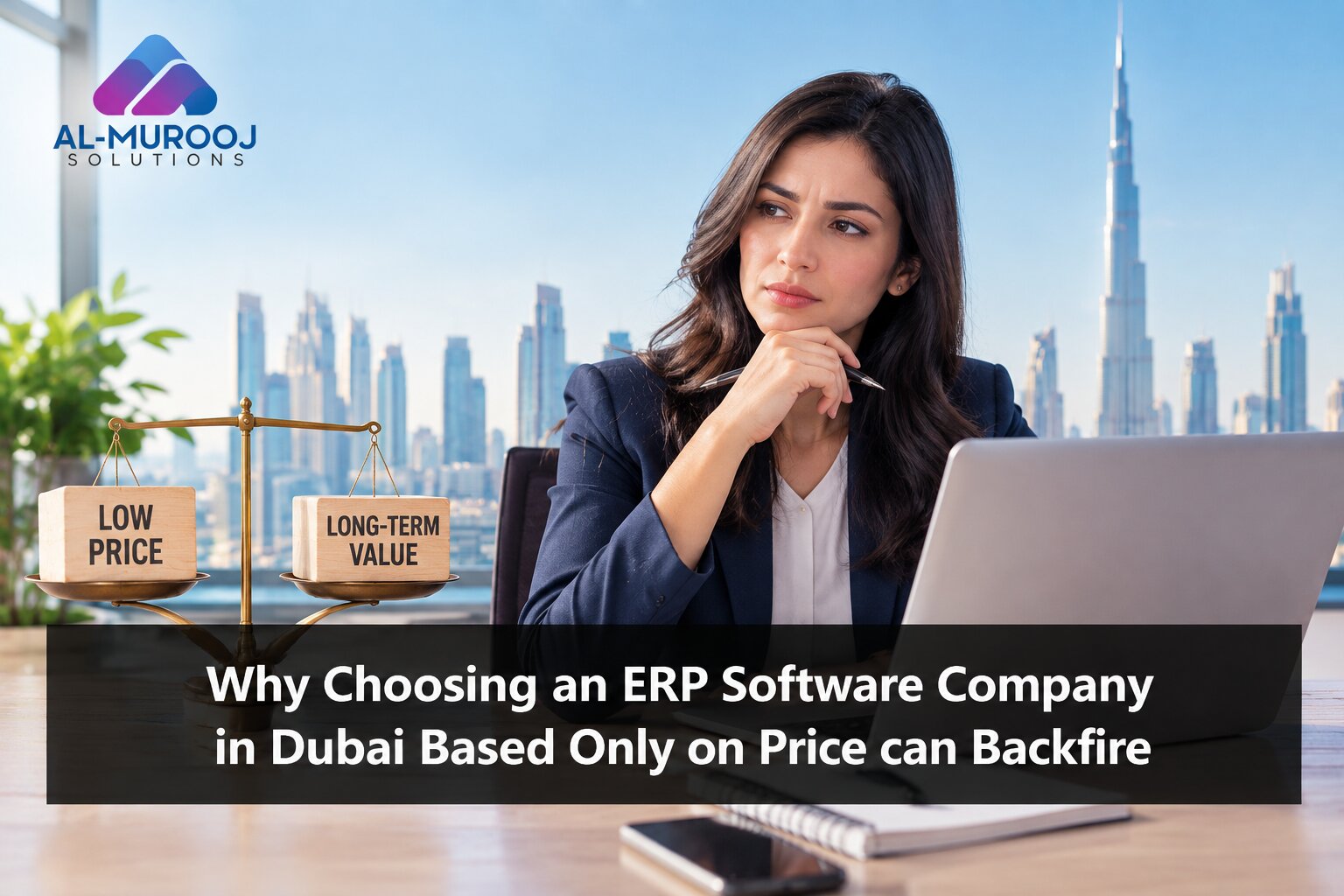
Two ERP proposals land on your desk. One is noticeably cheaper. At first glance, it looks like the obvious choice.
That reaction is completely understandable. The upfront number is the one thing you can actually see. Your management team has a fixed budget. Comparing two implementation quotes side by side feels simple. A lower quote feels like the safer, lower-risk option – especially when the costs that show up later are much harder to predict before the system is even running.
But here’s the distinction that matters: the initial price from an ERP software company in Dubai is not the same thing as the total cost of owning and running that system over time. That’s a gap Al Murooj Solutions sees Dubai businesses run into again and again, and it’s what people usually mean when they talk about total cost of ownership – it rarely shows up on the first invoice. .
This isn’t an argument against affordable ERP software. A lower quotation can be a completely rational choice when the buyer simply can’t see the costs that come later. So the real question isn’t “which quote is cheaper today?” It’s “what isn’t this quote showing me yet?”
The Initial ERP Quote Doesn’t Show the Full Cost of the Decision
User Growth Can Change the Economics
No business stays the same size forever. If your ERP pricing is tied to the number of users, every new hire, branch, or department can quietly push that software cost upward.
The important question isn’t “what does this system cost today?” It’s “what happens to that cost as my business grows?”
The Cheapest Package May Not Contain the Workflows You Actually Need
There’s a real difference between basic functionality, the workflows your business genuinely depends on, optional modules, integrations, and custom add-ons.
Feature count isn’t the useful measure here. What matters is whether the capabilities your specific business needs are already part of the system or whether the cheap package is really just a stripped-down version of what you’ll eventually be forced to buy.
Customization Can Change the Economics
Sometimes a business only discovers after implementation that an important workflow doesn’t fit the system naturally. That can lead to custom development, manual workarounds, connecting yet another separate tool, or eventually redesigning parts of the setup.
Not every rigid system leads here automatically – but it’s a cost worth investigating before signing, not after.
The Real Comparison Is Software Cost Plus Business Consequences
Put simply: what an ERP costs you is the software price, plus what it takes to make that software actually work for your business, plus the operational cost created when the system doesn’t properly support critical processes.
That last part is where things get interesting, because an ERP can become expensive without ever sending you another invoice.
The ERP Can Become Expensive Without Sending You Another Invoice
Fragmented Information Creates Operational Blind Spots
When availability, contracts, delivery, maintenance, returns, and billing all live separately, employees end up manually reconciling information. That opens the door to outdated data, duplicate entries, missed updates, and conflicting records.
The real value of integration isn’t just “it saves time.” It’s that the information needed for your next decision is still there when you need it.
A Missed Workflow Can Become Lost Revenue
If delivery, return, and damage information isn’t connected to billing, the business has to manually catch every late return, every damage charge, and every extra usage fee. Not every disconnected system automatically loses money – but every manual handoff is one more place a billable event can slip through unnoticed.
Poor Maintenance Visibility Can Turn Software Limitations into Operational Disruption
For equipment-based businesses, maintenance depends on time or usage, availability depends on maintenance status, and customer commitments depend on availability. If those records aren’t connected, a missed maintenance flag can ripple straight into a broken customer commitment.
Case Study: What the “Cheaper ERP” Decision Looks Like Inside a Dubai Heavy-Equipment Rental Business
This industry makes the cost-of-ownership issue especially visible: high-value equipment, customer commitments, delivery logistics, maintenance requirements, rental periods, return condition, and billing all depend on each other. Let’s follow one piece of equipment through its full lifecycle.
Availability
Before accepting a booking, the business needs to know whether the equipment is available, already committed, undergoing maintenance, or sitting at a different location. If that information is fragmented, the business risks committing equipment that isn’t actually free – leading to double-booking, idle equipment, or a disrupted customer.
Booking – Contract
Once booked, the rental agreement needs to reflect the rental period, agreed rates, customer, equipment, and terms. If booking and contract information sit apart, staff end up recreating or reconciling the same details twice, with more room for error each time.
Delivery
The equipment leaves the yard and enters the customer’s project. This is where integration stops being an abstract idea – the system becomes genuinely valuable only when the same equipment record continues through the next business event instead of restarting somewhere else.
Usage – Maintenance
During the rental period, usage and maintenance requirements need tracking. If that tracking happens manually, service requirements can be overlooked – which can affect equipment availability, repair costs, and customer commitments.
Return – Damage Assessment
When equipment returns, the job isn’t finished. The business needs to record the return, its condition, any damage, and applicable charges. This is one of the clearest revenue-leakage points: if damage information sits separately from billing, a company can know equipment came back damaged without that fact automatically reaching the invoice.
Billing
The final stage connects the operational lifecycle back to revenue – the invoice needs to reflect the full chain: contract, usage, return, damage, and any other billable events.
Case-study takeaway: the cheaper ERP isn’t necessarily expensive because its license costs more later. It becomes expensive because the business ends up paying for the gaps between its own workflows.
So How Should a Dubai Business Compare ERP Cost?
Whether you’re looking at Oreon or comparing several ERP software solutions in Dubai, the same four questions apply before you sign anything.
Compare the cost of growth. What happens to your software cost as you add people, branches, or operations?
Compare the cost of required functionality. Are the workflows your business depends on already part of the system you’re evaluating, rather than something you’ll need to add later?
Compare the cost of fragmentation. Will employees be moving information between systems, spreadsheets, and disconnected modules just to complete normal processes?
Compare software cost with operational value. Weigh the ERP against what it actually helps you control – asset utilization, revenue capture, maintenance, workflow efficiency, visibility, and billing accuracy.
How Oreon ERP Addresses These TCO Concerns
On the concern of software cost rising as the workforce grows, Al Murooj Solutions positions Oreon around unlimited users, so headcount growth isn’t automatically tied to a rising bill.
On the concern of recurring licensing affecting long-term cost, Oreon is built around a one-time investment and licensing model rather than an ongoing subscription.
On the concern of important capabilities becoming fragmented, Oreon is positioned as an integrated ERP suite rather than requiring the business to assemble its core workflow across disconnected systems — the kind of approach a capable software development company in Dubai should be building toward in the first place.
On the concern of operational workflows sitting outside the ERP, Oreon’s modules are designed to keep business functions inside the same environment rather than pushing the business toward extra third-party tools.
To be clear: none of this automatically makes Oreon “cheaper.” It changes what the buyer needs to consider when calculating long-term cost. Going back to the rental example, the relevant question isn’t how many modules Oreon has – it’s whether it can follow the equipment record through the full lifecycle, from asset to booking to contract to delivery to maintenance to return to billing, without forcing the business to reconstruct that trail manually. That kind of continuity is exactly what distinguishes genuinely useful rental ERP solutions from ones that only look complete on paper.
Businesses evaluating Al Murooj Solutions for this kind of assessment typically start by comparing their current workflow gaps against what Oreon already covers out of the box.
The ERP With the Lowest Initial Price Is Not Automatically the Lowest-Cost Decision
The goal was never to avoid affordable ERP software. It’s to define “affordable” correctly.
When comparing your options, look beyond the opening quotation, the feature count, and the implementation price alone. Consider how the system scales, what functionality is genuinely included, how much customization may be required, how well workflows connect, and what happens to revenue, assets, and maintenance when information stays fragmented.
A lower ERP quotation is only cheaper if it stays cheaper after the business starts actually using it. The businesses that get this right are the ones that judge ERP companies in Dubai by what happens months into daily operation, not by what looks good on the day the contract is signed.
Ready to Look Past the Quotation?
If your business is weighing ERP options based on long-term cost rather than just the opening number, it helps to talk it through with someone who can look at your actual workflows, not just a feature list.
Al Murooj Solutions can assess whether Oreon’s one-time licensing, unlimited users, and integrated ERP structure genuinely fit how your business operates – from asset tracking to billing.
Reach out to walk through your requirements: call +971 4 335 4188 or +971 56 560 2357, or visit the team at 32 2C Street, Al Hamriya, Dubai, United Arab Emirates.